Free US shippingTry it for 30 days2-year warranty
How it works

Why your face holds water, and why it stays.

You cut the salt, you drink the water, you lost the weight or never had any to lose, and your face is still puffy at 7 a.m. You already suspect it's water. What nobody told you is where that water is supposed to go, and what's sitting on the way out. You can check both on your own face and neck before you reach the bottom of this page.

Reviewed by Dr. Brandon Bridgeman, DC · Updated November 2026

The way water leaves your face The muscle that turns your head The kink, under your ear Where the water backs up
Fig. 1A foot on a garden hose. The water keeps coming and can't get past.
Dr. Brandon Bridgeman, DC

"If the drain is clogged, the water stays, period."

Dr. Brandon Bridgeman, DCSports chiropractor and performance physio
How to read this page Every claim carries one of four labels, and a number that links to its source.
Textbook anatomy

It's in the anatomy books. Nobody argues about it.

Clinical practice

What hospitals and therapists do with patients every day.

Published study

Measured on people, in a journal. We say who was studied.

Dr. Brandon's clinical view

What he sees with his hands on necks. Nobody has run a trial on it.

Start here

First, find out which one you have.

Fat is slow. It takes weeks to gain and weeks to lose, and it looks the same at breakfast as it does at dinner.

Water is fast. It moves in hours.

So take a photo of your face the minute you wake up. Take another at 5 p.m. Same spot, same light, chin level.

If the 7 a.m. face is rounder, the difference between those two photos is water. Fat doesn't leave by dinner. Bone doesn't either.

If the two photos match, this probably isn't your problem, and Hizoo isn't likely to change your face. You'd want to know that before you spend anything.

A woman's bathroom-mirror selfie at 7:02 in the morning, her face puffy under the eyes and in the cheeks7:02 AM
The same woman at the same mirror at 5:14 that afternoon, her cheekbones and jawline showing5:14 PM
Same day. Same weight.Same mirror, same light
Self-test 01That's the clock test. A lot of people have already run it without the camera: puffy at 7 a.m., cheekbones by 5 p.m., puffy again the next morning.
The route

Your face has no drain of its own.

Textbook anatomy

Fluid seeps into your face all day and all night. That part is normal.

It leaves one way. From your cheeks, your eyes and your jaw it moves into small lymph nodes in front of your ears and under your jawbone. From there it runs down a chain of nodes on the side of your neck. It goes back into your blood just above your collarbone.4

That route is textbook anatomy. Gray's Anatomy says it in a sentence: all lymphatic vessels of the head and neck ultimately drain to the deep cervical lymph nodes.1 "Deep cervical" means deep in the neck.

Your head and neck hold about 300 lymph nodes, out of roughly 800 in your whole body.3

1 2 3 4
  1. Your faceIt makes fluid all day and all night, and it has no drain of its own.
  2. In front of your ears and under your jawSmall nodes collect the fluid here first.
  3. The side of your neckA chain of nodes runs down under the thick muscle that turns your head. This is where it kinks.
  4. Just above your collarboneThe way out. From here the fluid is back in your bloodstream.
Fig. 2Where your face drains: in front of the ear, under the jaw, down the side of the neck, out above the collarbone.

That chain sits under one thick muscle.

Textbook anatomy

Turn your head to the left. A thick cord stands out on the right side of your neck, under your ear. That's the sternocleidomastoid. Everyone shortens it to SCM.

Most of the nodes in the chain lie underneath it.2 When surgeons need to reach them, they pull the muscle aside first.2

So the only way out of your face runs under a muscle you tighten every time you look down.

Lymph nodes on the way out The SCM, lying over them
Fig. 3Most of the chain lies under the muscle that stands out when you turn your head.
The part nobody told you

What ten years of looking down does to that muscle.

Dr. Brandon Bridgeman working on a client's neck in his clinic In his clinic

Count the hours your chin is down. Phone, laptop, steering wheel, phone again.

Held like that for years, the SCM shortens and stays tight. Dr. Brandon Bridgeman has spent fifteen years with his hands on the necks of fighters and bodybuilders. This is how he explains what he finds:

Dr. Brandon's clinical view

"When you spend all day looking down at phones or screens, the SCM shortens and tightens. It acts like a kink in a garden hose. The fluid tries to leave your head, hits the SCM blockage, and backs up, creating that round, undefined moon face you hate seeing in photos."

Dr. Brandon Bridgeman, DCSports chiropractor and performance physio

Who Dr. Brandon is

Picture a foot on a garden hose. The water keeps coming. The hose swells behind the foot and not much comes out the other end.

In your face, "behind the foot" is under your eyes, in your cheeks and under your chin.

State 01 · Kinked

The drain is pinched.

The water comes down from your face, hits the kink and backs up.

The pinch test

Find it on your own neck.

Turn your head to one side. Pinch the cord that stands out under your ear. If it's hard, or it's sore, your neck is tight right where your face drains.

Self-test 0210 seconds
A woman with her head turned, pinching the cord that stands out on the side of her neck A man with his head turned, pinching the cord that stands out under his ear
  1. Turn your head to the left.
  2. A thick cord stands out on the right side of your neck, under your ear.
  3. Pinch it.

If it's hard, or it's sore, that's the muscle sitting on your drain.

Salt, wine and a bad night add water. The kink is why it stays.

You already know what makes a morning worse.

Published study

Start with lying flat. While you're upright, gravity pulls fluid down toward your legs. Lie down for eight hours and it drifts back up toward your neck and head. Sleep researchers have measured it.5 Astronauts live with a version of it, and NASA calls it "puffy face".6 It's one reason 7 a.m. is your worst hour.

Salt makes your body hold extra water to deal with it. A couple of glasses of wine and you hold more fluid the next morning. A short night shows up as swollen eyes, and that has been measured too.7 For a lot of women, add the days around a period.8

Dr. Brandon's clinical view

Everybody gets these. Two friends eat the same sushi and drink the same two glasses, and only one of them wakes up round. They had the same dinner. What's different is how fast each face drains.

With an open neck, last night's water is gone soon after you're up and moving. With a kinked one it takes until late afternoon, or it never fully clears before the next night adds more. That's the face that looks 20 pounds heavier than the body under it.

It's also why you cut salt and still wake up with the same puffiness. Cutting salt lowers what comes in. It does nothing for the way out.

Two women laughing in a restaurant booth over a board of sushi and two glasses of white wine
Same dinnerOnly one of them wakes up round. What's different is how fast each face drains.

A lymphatic therapist works your neck before your face.

Clinical practice

If you've ever paid for a lymphatic facial, the first few minutes were spent nowhere near your face.

That's the standard order. In MD Anderson Cancer Center's patient video on lymphatic self-massage, the physical therapist says "we always start at the neck".9 An NHS leaflet for patients with head and neck swelling tells them to empty the nodes "at the neck, ears and collar bone" before they work on the face.10

Neck first, then face. Push fluid toward an exit that isn't open and it has nowhere to go.

Hizoo is that first step, done for you every night.
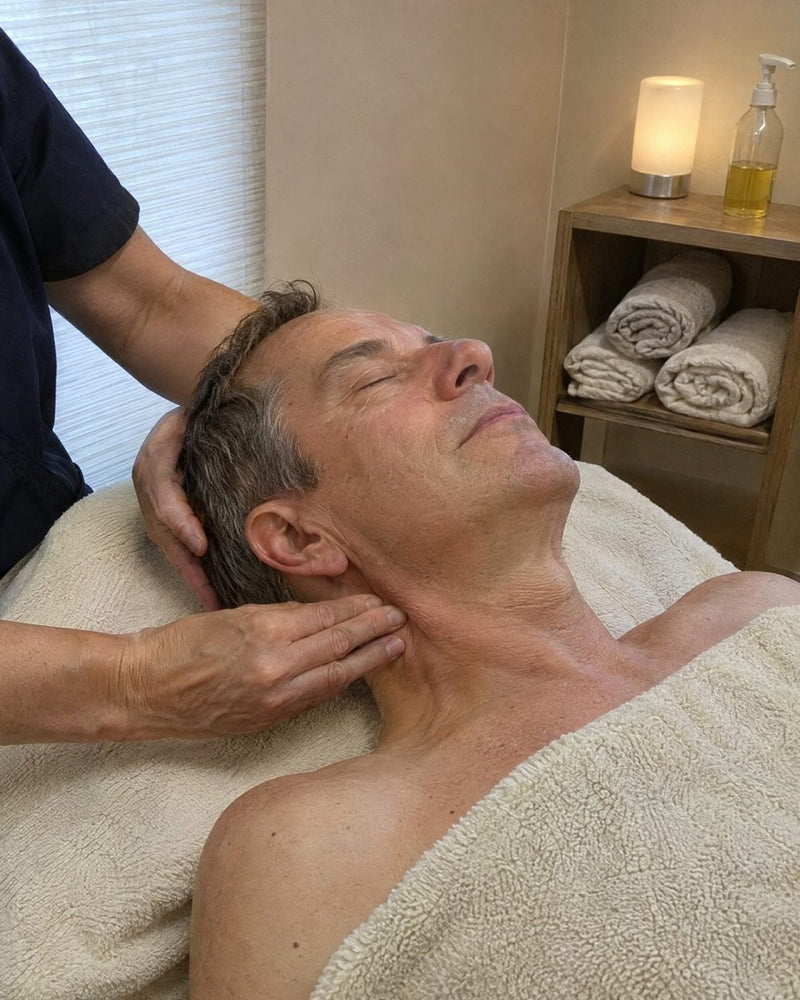
A massage therapist's hands on a man's neck in a treatment room, one hand cradling his head and the other pressing along the side of his neck
Neck firstThe first minutes of a lymphatic session are spent on the neck, not the face.
Clinical practice
"So we always start at the neck, because right below the neck is the last place the fluid drains back to the heart."
A lymphedema physical therapist in MD Anderson Cancer Center's patient video9
Clinical practice
"Empty the lymph nodes (x 4) at the neck, ears and collar bone"
Calderdale and Huddersfield NHS Foundation Trust, Lymphoedema Service, head and neck leaflet10
ThermoKnead™ 3D

Heat, knead, stretch.

Years of looking down compress the side of your neck where your face drains. Hizoo decompresses it three ways at once.

01 · Kinked

The drain is pinched.

Your chin is down most of the day. The muscle on the side of your neck shortens and locks, and the water backs up into your face.

02 · Heated

Heat softens it. Kneading works it loose.

Hizoo warms the muscle to 108°F while four kneading heads grip and release the back and sides of your neck.

03 · Open

The water has somewhere to go.

The muscle lets go, the side of your neck decompresses, and your face drains the way it's built to.
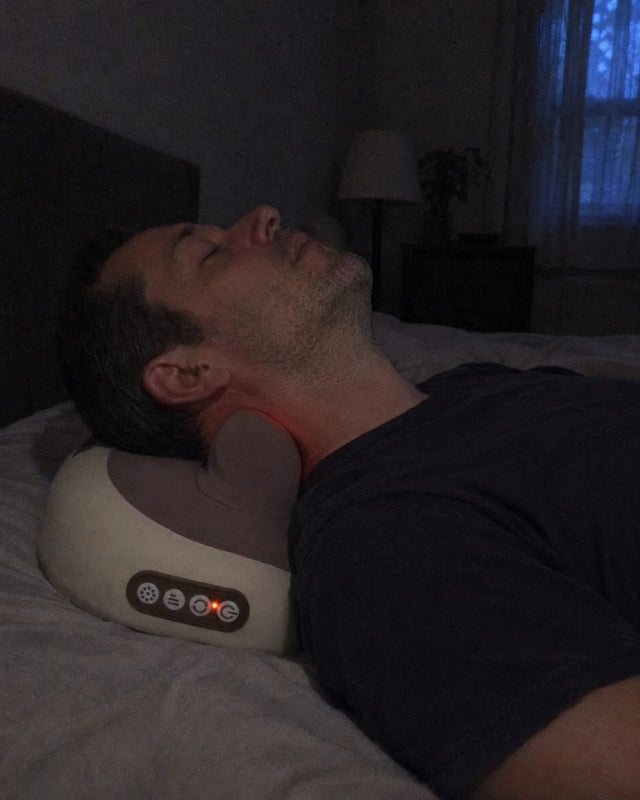
Fig. 4The same neck in three states: kinked, heated, open.
A man asleep in a dark bedroom with Hizoo under the back of his neck, the heat light lit on the control panel
01 · HeatWhat the heat does.

A cold, tight muscle guards itself when you press on it. A warm one gives. Hizoo warms to 108°F against the back and sides of your neck, so the muscle is ready before the kneading goes deep.

Clinical practice
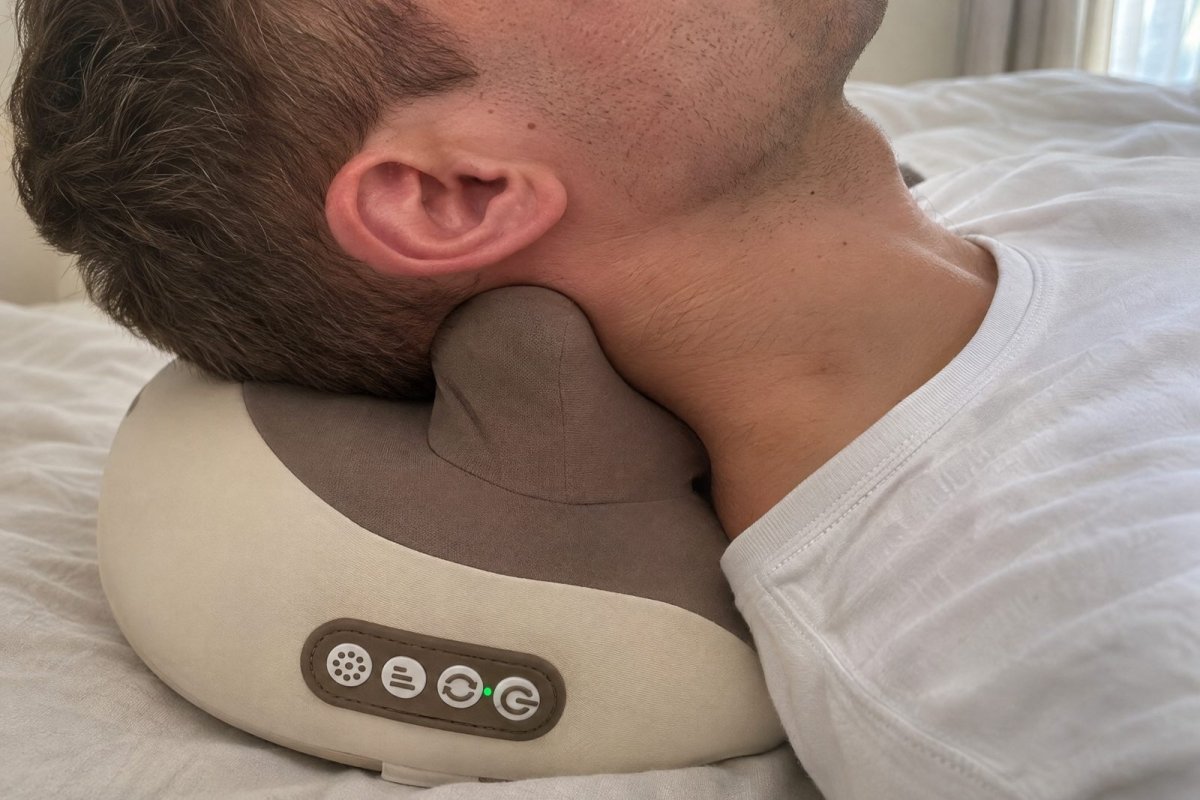
Close side view of Hizoo under the back of a man's neck, a kneading head pressed into the muscle below his ear, buttons to the side
02 · KneadWhat the kneading does.

Four kneading heads grip and release the back and sides of your neck, the way a therapist's thumbs do. Grip, let go, grip, let go. In Dr. Brandon's words, "It's the first mechanical tool that replicates the grip and release technique I use in the clinic."

Dr. Brandon's clinical view
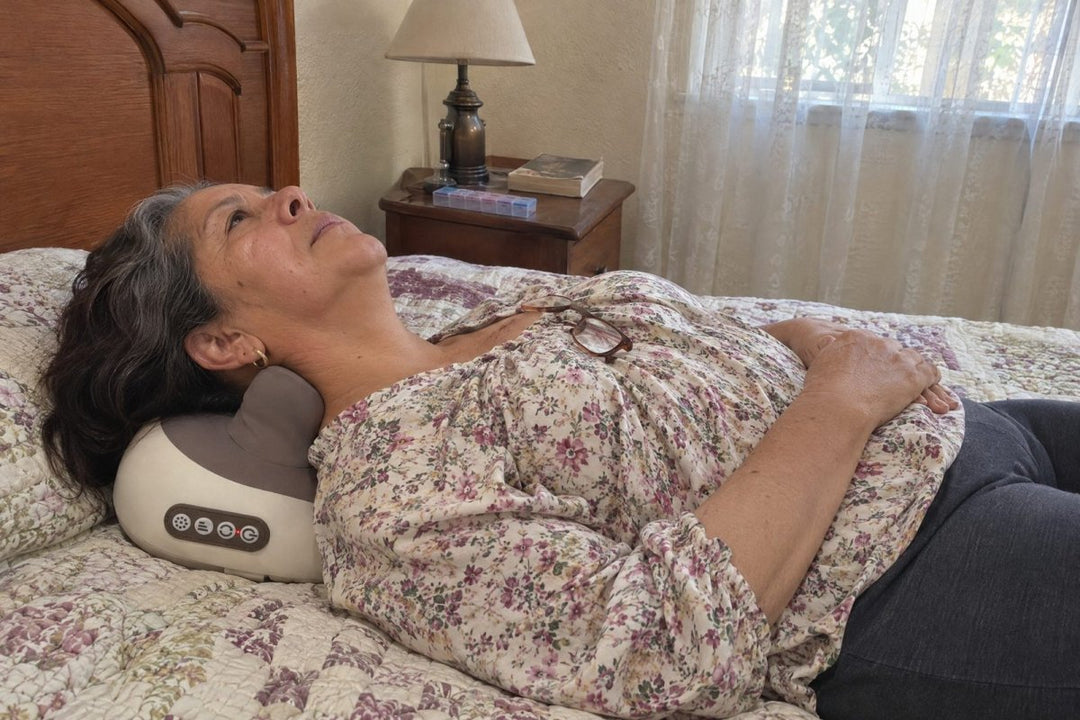
A woman lying back over the curve of Hizoo on a bed, her head tipped back and the front of her neck stretched long
03 · StretchWhat the stretch does.

Hizoo is curved. Lie back on it and your head tips back, your chin comes up and the front of your neck opens long. It's the reverse of the position your phone holds you in all day, so the muscle gets warmed and worked while it's lengthened.

Ten minutes, then it turns itself off. You lie there.

"You aren't massaging yourself. You are mechanically reopening a drainage valve."
Dr. Brandon Bridgeman, DC Dr. Brandon Bridgeman, DCSports chiropractor and performance physio

ThermoKnead™ 3DPatented designU.S. Design Patent D1,086,746

What you'll notice, and in what order.

Most people believe it in their ears before they believe it in the mirror.

  1. A few minutes in

    Warmth, then a deep knead. Then, for a lot of people, something lets go. Dr. Brandon on his own first session: "I felt my ears pop and the pressure drop." Customers describe the same moment their own way.

  2. Tomorrow · 7:00 AM

    Look under your eyes and along your jaw. That's where it shows first.

  3. About a week in

    Somebody asks what you changed.

Dec 2025
A few minutes in

"What an amazing feeling! I instantly felt my nasal congestion subside."

Frank M. Verified buyerShortened

Jun 2025
While it runs

"I can feel my sinuses drain while I am using it."

Kelley O. Verified buyerShortened

Sep 2026
Right after

"But then I just felt lighter. It was immediate."

Lori C. Verified buyerShortened

It's a firm knead, and the first sessions on a tight neck can feel like a lot. Start on the lowest strength.
How to use it, and how to make it fit

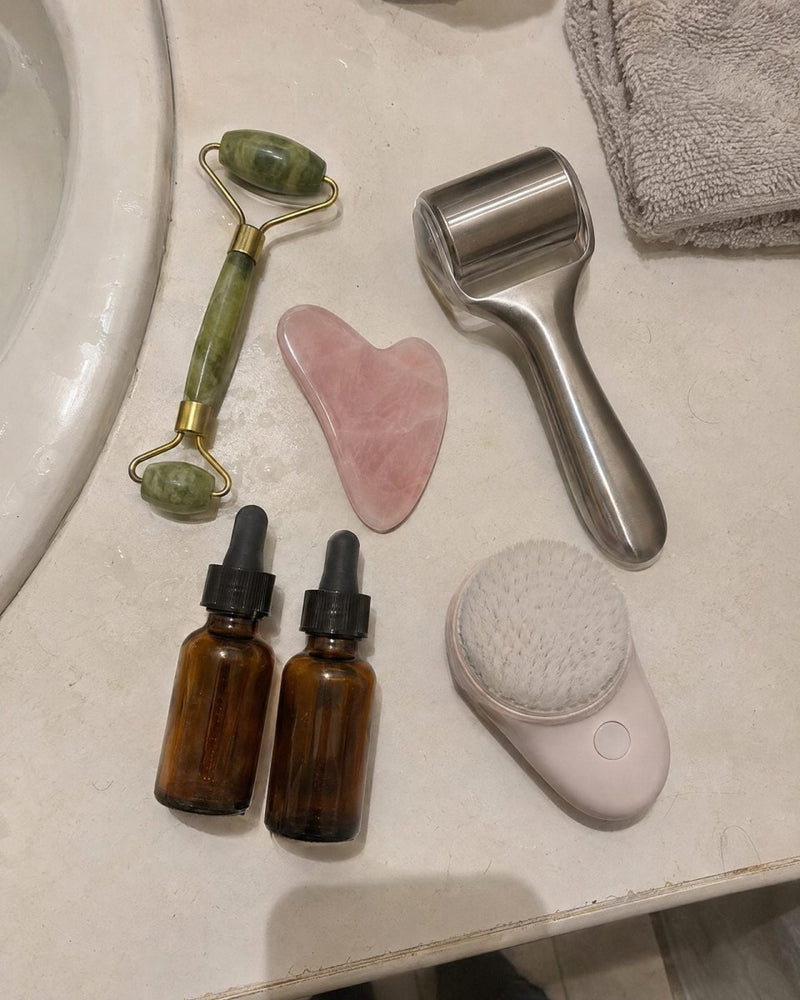
A bathroom counter seen from above with a jade roller, a gua sha stone, a steel ice roller, two dropper bottles and a face brush

You've been working at the wrong end.

Dr. Brandon's clinical view

The ice roller, the gua sha, the cold spoon, the face brush: they all do something. For about an hour your face looks better, because you've chilled the water or pushed it somewhere else. Then it settles back, and tomorrow morning it's the same face, because the way out was never opened.

"This is why your diets aren't working, why you look swollen even when you're hydrated, and why those ice rollers only last for about 20 minutes before the bloat comes back."
Dr. Brandon Bridgeman, DC Dr. Brandon Bridgeman, DCSports chiropractor and performance physio

A diet takes fat, and this is water. Drops and teas go through your stomach, and your face drains through your neck.

Keep the gua sha if you like it. Do your neck first, and you're moving water toward a drain that's open.

Compare everything

The limits

Five limits, so you know before you buy.

Textbook anatomyThe route your face drains by is textbook anatomy.
Clinical practiceStarting at the neck is standard clinical practice.
Dr. Brandon's clinical viewThe kink, a tight SCM holding water in your face, is Dr. Brandon's clinical view from fifteen years of doing this work by hand. Nobody has run a trial on it.

You can run your own in a week with two photos and the same bathroom light.

The studies

What has been measured, and what hasn't.

Six published studies sit behind this page. None of them tested Hizoo. Each card says who was studied, what was found and what it doesn't show.

Published studyAmerican Journal of Respiratory and Critical Care Medicine · 2009

Lie down for the night and fluid moves from your legs toward your neck.

Who was studied
Men who were not overweight, measured before and after a night's sleep.
What was found
The more fluid left their legs overnight, the more their necks grew by morning.
What it doesn't show
It measured necks, not faces. That the same shift puffs your face is a fair step from it, and nobody has measured that step.
Read a summary of the follow-up
Published studySleep · 2013

A short night shows on your face as swollen eyes.

Who was studied
10 people photographed after a normal night and again after 31 hours awake. 40 people rated the photos.
What was found
The sleep-deprived faces were rated as having "more swollen eyes", more hanging eyelids and darker circles.
What it doesn't show
These are ratings of photos, and the differences were modest. It didn't measure fluid and it didn't test any treatment.
Read the study
Published studyObstetrics and Gynecology International · 2011

Fluid retention peaks on the first day of a period.

Who was studied
62 women who kept daily records across 765 menstrual cycles.
What was found
Self-rated fluid retention was highest on the first day of the period, and higher around the period than in the middle of the cycle.
What it doesn't show
The women rated it themselves. Nothing was measured, and the study wasn't about faces.
Read the study
Published studyBMC Oral Health · 2025

Drainage that started above the collarbone brought facial swelling down after surgery.

Who was studied
46 patients, aged 18 to 26, after wisdom-tooth surgery on both sides. A physiotherapist did manual lymphatic drainage on one side, starting at the nodes above the collarbone.
What was found
The treated side swelled less, measured with 3D scans of the face.
What it doesn't show
This is swelling from surgery, treated by hand in a clinic and followed for a week. It isn't everyday puffiness, and no device was tested.
Read the study
Published studyLymphology · 2007

Drainage on the neck alone left the face less swollen.

Who was studied
10 patients after wisdom-tooth surgery on both sides. Manual lymphatic drainage was done on the neck on one side, and the other side was left alone.
What was found
Four of six measurements showed significantly less swelling on the side where the neck was treated.
What it doesn't show
Ten people is a very small study, and this is swelling from surgery. No device was tested.
Read the study
Published studyJournal of Craniofacial Surgery · 2017

After jaw surgery, swelling went down faster with lymphatic drainage.

Who was studied
30 patients after surgery on both jaws, in a randomized, double-blind trial. Half had manual lymphatic drainage.
What was found
Measured facial swelling came down faster in the drainage group.
What it doesn't show
It didn't help their pain, and the patients themselves didn't notice a difference in swelling. Again, this is swelling from surgery, treated by hand.
Read the record

No study has measured whether a tight neck muscle slows the drain from the face, and no study has tested Hizoo. On this page that step is labeled as Dr. Brandon's clinical view.

The Hizoo Fluid Release Decompression Massager

Hizoo Fluid Release Decompression Massager

The neck massager made for water weight in your face.

4.9 from 4,500+ reviews
Try It for 30 Days
Try it for 30 days
Free US shippingShips in 1 to 2 business days
2-year warranty

Try it for 30 days. If your face looks the same, send it back for a refund, minus $15 return shipping. The fine print

You pay once. No refills, no subscription.

Take a photo tonight. Use it ten minutes a night. If your face looks the same in 30 days, send it back for a refund, minus $15 return shipping.

Try It for 30 Days
Where these facts come from

Reviewed by Dr. Brandon Bridgeman, DC · Updated November 2026

  1. Textbook anatomy
    Gray's Anatomy, 42nd edition, p. 593, on the deep cervical lymph nodes. "All lymphatic vessels of the head and neck ultimately drain to the deep cervical lymph nodes." Read in the reference entry.
  2. Textbook anatomy
    Superior deep cervical lymph nodes. "Most of these lymph nodes are situated deep to the sternocleidomastoid muscle." Reference entry. Surgeons retract the muscle "to expose the internal jugular vein and lymph node chains": Nguyen, Higueras, Suami, Carrera Burgaya, Hong, Archives of Plastic Surgery, 2026. Paper
  3. Textbook anatomy
    Sakr M, Head and Neck and Endocrine Surgery, Springer, 2016. "The neck region contains around 300 lymph nodes (LNs) out of 800 LNs in the whole body." Chapter
  4. Textbook anatomy
    TeachMeAnatomy, Lymphatics of the head and neck. The nodes in front of the ear and under the jaw, and where the trunks empty near the collarbone. Article
  5. Published study
    Redolfi S and colleagues, 2011. On fluid moving from the legs toward the neck when lying down, summarized by ScienceDaily. Summary
  6. Space agency report
    NASA, Space Station blog, January 22, 2019. On "puffy face" in astronauts. Post
  7. Published study
    Sundelin T and colleagues, Sleep, 2013. Sleep-deprived faces were rated as having "more swollen eyes". Study
  8. Published study
    White CP and colleagues, Obstetrics and Gynecology International, 2011. Self-reported fluid retention peaks on the first day of the period. Study
  9. Clinical practice
    MD Anderson Cancer Center, lymphedema self-massage video transcript. "So we always start at the neck, because right below the neck is the last place the fluid drains back to the heart." Transcript
  10. Clinical practice
    Calderdale and Huddersfield NHS Foundation Trust, Lymphoedema Service, head and neck self lymphatic drainage leaflet. "Empty the lymph nodes (x 4) at the neck, ears and collar bone". Leaflet
  11. Published study
    Ulu M and colleagues, BMC Oral Health, 2025. Manual lymphatic drainage after wisdom-tooth surgery, 46 patients, swelling measured with 3D imaging. Study
  12. Published study
    Szolnoky G and colleagues, Lymphology, 2007, and Yaedú RYF and colleagues, Journal of Craniofacial Surgery, 2017. Two small trials of manual lymphatic drainage on swelling after oral and jaw surgery. 2007 study and 2017 record

None of these sources tested Hizoo. They describe the anatomy and the order clinicians work in. Dr. Brandon Bridgeman's quotes are from his own video for Hizoo. MD Anderson, the NHS and NASA are not affiliated with Hizoo.

Hizoo Fluid Release Decompression Massager
Try It for 30 Days